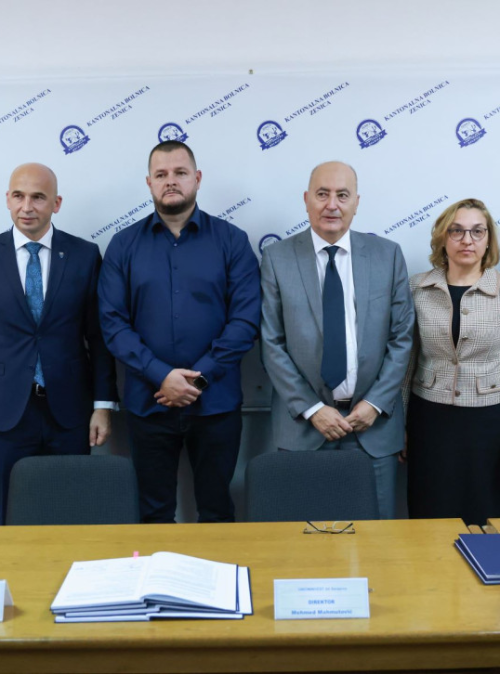
EU and EBRD finance the renovation of Zenica Cantonal Hospital
The contract for replacing the boiler system at the Zenica Cantonal Hospital was signed 23 October 2025, marking the start of the first phase of the renovation of the Hospital, which will significantly improve its energy efficiency.
Thanks to a €1 million grant from the European Union and a €10 million loan from the EBRD, the hospital will get a modern heating and ventilation system, thermal insulation, new windows and doors, and a new energy-efficient annex with a total area of 2,800 m².
These improvements will significantly reduce energy consumption and harmful gas emissions, while providing patients and staff with more comfortable and healthier conditions.
“Today is an important day for the citizens of Zenica and the entire canton. Projects like this one bring tangible benefits to people, cleaner air, lower energy costs and better healthcare services. Energy efficiency is one of the most effective ways to reduce pollution and protect public health, and it is a key part of the EU’s Green Agenda. Energy consumption in BiH is still four times higher than the EU average, which shows how much potential there is for savings and modernisation. The European Union remains firmly committed to supporting Bosnia and Herzegovina on its path toward sustainable development and alignment with European standards,” said Karel Lizerot, Head of the Section for Good Governance at the EU Office in Bosnia and Herzegovina.
Built in 1959, the Zenica Cantonal Hospital is one of the largest healthcare institutions in the country and one of the main sources of air pollution in the city. With 950 beds and 1,600 employees, the hospital provides services to more than 300,000 patients each year. That is precisely why its energy renewal is a key step towards cleaner air and a more modern health system.
"Together with our partners, we are creating prerequisites for the construction of new hospital capacities that are energy efficient, environmentally friendly and sustainable. This project brings not only energy savings, but also improved conditions for patients, staff and citizens. Together, we are showing today how much can be achieved by working together for the benefit of all, and that Zenica can lead by example in energy efficiency in line with the EU standards," said Tarik Zulović, Director of the Zenica Cantonal Hospital.
This initiative is part of Zenica’s Green Cities Action Plan, developed in partnership with the EBRD’s Green Cities Programme, which supports cities in tackling environmental challenges and improving quality of life.
“This project is a powerful example of how targeted investment in the public sector can deliver significant benefits for the environment,” said Stela Melnic, EBRD Head in Bosnia and Herzegovina. “We are eager to continue supporting Bosnia and Herzegovina in making its building sector greener and more energy efficient.”
After the completion of the project, the hospital will reduce energy consumption by more than 60%, and CO₂ emissions by up to 80%. This means lower costs, less air pollution and better working conditions for medical staff.
The European Union remains the largest donor and partner to Bosnia and Herzegovina in the energy sector, providing hundreds of millions of euros in the renovation of public buildings, the development of renewable energy sources and pollution reduction. The Zenica Cantonal Hospital energy renovation project is part of the EU Regional Energy Efficiency Program for the Western Balkans (REEP). Through REEP and other initiatives, the EU supports Bosnia and Herzegovina and the counties in the region to reduce energy consumption, modernise public facilities and comply with the EU energy and environmental standards.
___
About REEP
Launched in 2013 under the Western Balkans Investment Framework (WBIF), the Regional Energy Efficiency Programme (REEP) supports renewable energy and energy efficiency investments across the region. With over €1 billion mobilised to date, it has refurbished more than 90 public buildings, supported 1,500 SMEs and 20,000 households. The achieved annual CO₂ emissions saved is equivalent to removing 183,000+ cars from the roads.
___
About WBIF and Global Gateway
The Western Balkans Investment Framework (WBIF) contributes directly to Global Gateway, the EU’s strategy to boost smart, clean and secure connections in digital, energy and transport, while strengthening health, education and research systems worldwide. Global Gateway aims to mobilise up to €300 billion worldwide in investments through a Team Europe approach, bringing together the EU, its Member States and financial institutions to leverage investments for a transformational impact.